
July 23th, 2026, Jiyan Düyü and Melle van Herwaarden
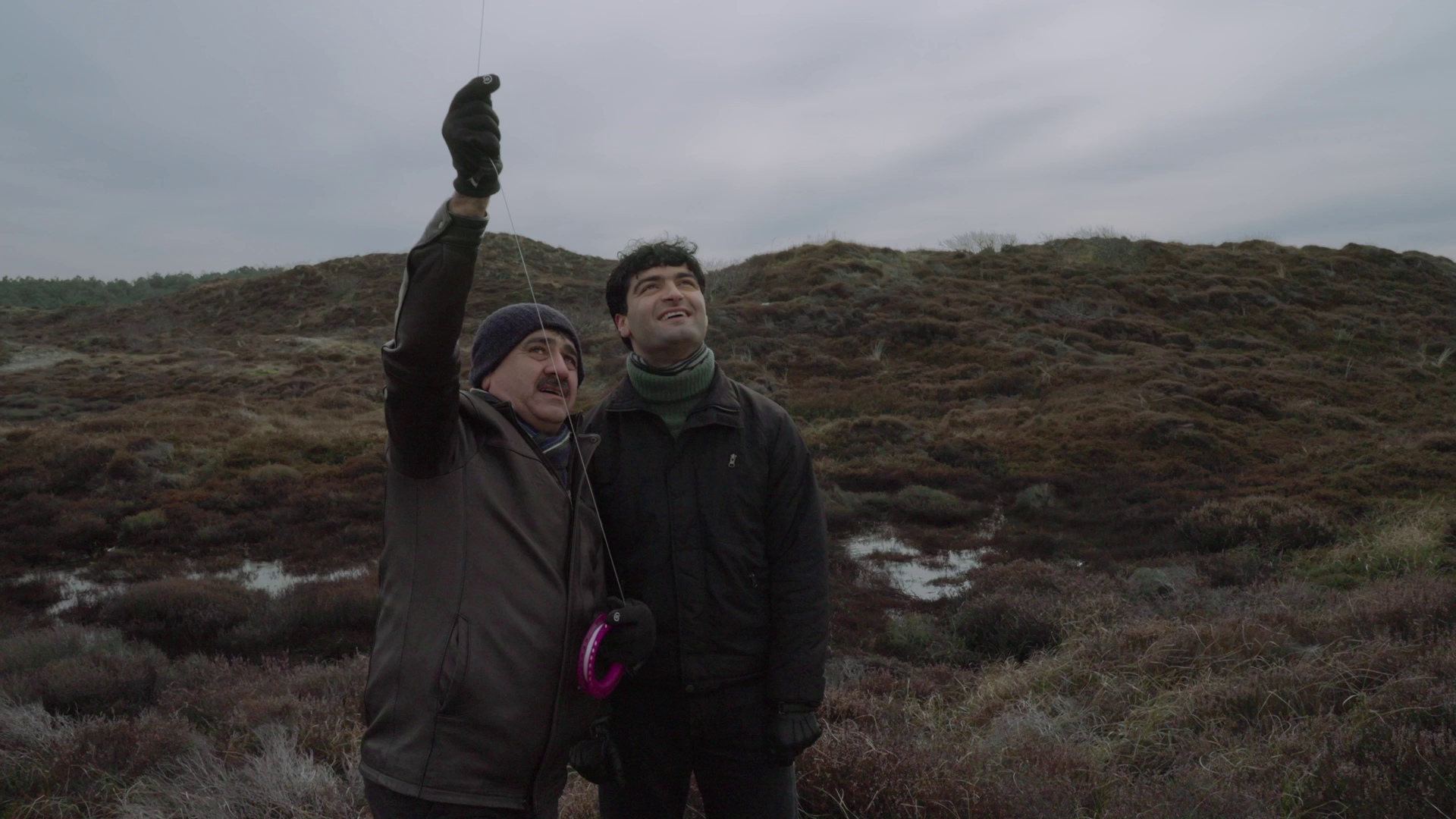 Jiyan Düyü, Hengaw and Namik, 2025. Still.
Diego Diez: I had this idea of making this conversation because I saw these connections between your practices. The clearest one was that interest in the subject, usually a human subject, connected with performance, with their gestures. When we talk about your films, we talk about the silences. Of course, in painting, silence is present because there is nothing happening. It's only silence. I was curious how you see that overlapping.
Melle van Herwaarden: I think in Jiyan's case there is a constructed situation before the actual. There's a lot of pre-work. The whole film setting feels very natural, at least I feel so when I look at her films. But all the natural that you see is constructed within that pre-work. It is not, how do you say that, performed. There goes a lot of work into creating a situation, which makes it fascinatingly natural. However, its preconditions are very well thought out, so the people filmed can be themselves.
Jiyan Düyü: I construct the situation. I direct myself into a situation, and I'm not directing the characters. And I think for you, you do the opposite. You direct the characters in your paintings.
Melle: I direct in a minimal way to be able to depart from a traditional portrait. I always want to take it from a portrait to something like a scene. It can be very small. Guiding Tom into certain positions, all of a sudden you create this line between fiction and non-fiction, because he is acting, but he is in my studio. He is aware of the situation that feels more like a photoshoot but him adopting a specific pose or mimicking Pina Bausch lifts the imagery into something less graspable.
Jiyan: At the same time, putting a camera on someone is already performative. Even now, we are sitting here, and I feel like we are performing something.
Melle: That is the biggest overlap. The awareness of being looked at, or filmed, or observed. But in the outcome of the practices, it is not exactly the core of what you look at.
Jiyan: No, because in my work, one of the main aspects that I try to put emphasis on is the empathetic.
Melle: You really centralize empathetic qualities within people.
Jiyan: I also try to demand an empathetic view from the audience. When people see it in one minute, then they understand the concept. But if they look at it for five or ten, then they see the details that could soften the view on the ‘other’.

Melle van Herwaarden, Tom (Thelonious Monk, Pina Bausch), 2026 Oil on linen, 116 x 89 cm (45 3/4 x 89 in)
Diego: We all studied in the same school (Gerrit Rietveld Academie, Amsterdam), but you studied in the VAV department, which for me, in fine arts, was always this more weird thing that I never really understood. I'm wondering if you feel the camera was more relevant or present in your education.
Jiyan: Yeah, it was. Already since I was nine I had a camera in my hand. From the basic year on, you touch upon all these different media, and the moment I got the camera, it was the moment that something ‘happened’ within the assignment as well as in the work. That was for me this click moment: this is what I'm good at; this is how I am able to translate my thoughts into image.
Melle: For me fine arts was always this place where, when I was in the basic year, it was very unclear to me what was happening there. I was fascinated with figurative painting. Everything that came out of VAV that year, I completely resonated with. I never really analyzed what it was, but I have the feeling now, when you mention the camera, there was a pursuit of more direct imagery of human beings. Even in the paintings or the sculptures they did, it was all quite related to that approach you have with the camera. That has become very evident in my choice to go to VAV: to be able to paint in a more traditional way, and it being considered contemporary. When I looked at fine arts, I was so confused about the vagueness of it. The camera at VAV gave me a lot of clarity. Context. Like, okay, it still exists somehow, to just portray someone.
Jiyan: And I honestly think in your work the viewer can feel camera movement as well. You can see the movement within the camera person, like walking around in one scene.
Melle: That is true. It is clear that I'm really observing. The camera allows me to do it from loads of angles in one day and to concentrate on key details.
Jiyan: That's the essence of what a camera is able to.
Melle: With painting figures you have to be focusing on that. That is the only thing you can focus on: those details within a gesture or a movement or a pose. That is what makes a painting great and sharp.
Jiyan: But you use your hands and paint for it?
Melle: I think in that way I slow down the observation. For me, the camera is really a tool to be able to quickly grasp something, and also not to have to have either my friend or someone else in front of me, because I find that quite confronting. Then all of a sudden it becomes this judgment both ways. And I find it good that there's a sort of secrecy still in my practice, that I can do it alone, and I have multiple images, and I can build one image from multiple images. A concealed way of using the photographs. But not in a voyeuristic way. Like Lucian Freud does it, I would not be able to. At least right now I don't have the interest for it.

Melle van Herwaarden, Pina Bausch (After Ulli Weiss), 2026 Oil on linen, 116 x 89 cm (45 3/4 x 89 in)
Diego: To a certain extent, some of your situations have been more constructed than others. If Melle is saying he's interested in that kind of silences and that moment translated to painting, what is it that you are trying to do?
Jiyan: I try to capture my reality, or direct surroundings as honest and realistic as possible. in the installations i want to bring the viewer very close to the intimate moment the people in my films have. The whole method of constructing those situations started at Birds Fly Back, my graduation film. From there I was adjusting new ideas into similar methods. Heaven must be like this, was the next project that sharpened my approach.
Melle: You adjusted the parts of the process that were difficult from Birds Fly Back. In Heaven must be like this you constructed the situation even more. You really controlled the situation.
Jiyan: I controlled the situation more, because I knew where the weak parts were.
Melle: For instance with Birds Fly Back, not having any children ready, but wanting to have children in the work. That was a very outrageous thought. We would go into the mountains. Finally, after two days, we found a location, and luckily there were children there. With all the other locations we got to, there were no children.
Jiyan: And they came to us, not the other way around.
Melle: That was a very lucky situation.
Jiyan: That was a lucky situation. With Heaven must be like this, it was a lucky situation too, because I didn't know who I was going to film beforehand. Only like two weeks before. And for a while i also didn't know what they were going to talk about. The situation and image of three men in this specific bar came first.
Melle: True, but you did ask your father very specifically: do we know people who would be great for it? And in that sense, your father really delivered. Because he came up with these three guys, one of them being your uncle. He said they will be very natural. So he really thought with you, in your way of thinking. If we would have done it the same way as in Turkey, we would have had a very different film. But the openness of these three guys really had to do with the constructed communication you had with your father.
Jiyan: And then with the last film, I saw my friend having a conversation with his father, and I was like, this is exactly perfect for my new idea. So I did, let's say, implemented the casting part within the method.
Melle: Sorry to interrupt, but this new casting step is again where your practice overlaps with mine i feel, because it is about being aware and sharp during daily life of who or what could embody ideas. Which movement, which gesture of someone, or which relationship with a father could work for the ideas i have? An approach that could lead to discussions of how far one can go by using someone for their practice. I think it all depends on the dialogue with potential cast, model or subject.
Jiyan: It's funny, I'm thinking about the new project I'm doing with a choir now. I went to a rehearsal and was observing everyone, like around a hundred people. And then I was like, no, I could work with anybody from the choir for this idea. I trust my ability to capture the detailed emotion I see in any singer. For instance, I saw the in-between moments where the conductor gives his notes, and then the way they look at him is already... It doesn't really matter what the face is. The way they look at him is already enough for me. You could say I developed this restricted way of observing people from Birds Fly Back until now.

Jiyan Düyü, Heaven must be like this, 2023. Still.
Diego: You are both talking about a method, and also about a situation that sometimes has a bit of chance, or luck. The practice is flexible enough to take some of those chance things. That method of being very present or aware of daily things, and then how to elevate them, or put a lens on them, magnify them.
Melle: The camera in that sense is that magnifying glass. And in both practices we always raise the question: who am I to make use of these people? That is something we talk about quite a lot.
Jiyan: With Birds Fly Back, the graduation film, I still feel that same question. I'm critical right now: who was I at that moment to film these people, especially because they didn't know they were going to shoot a film that day? Even though they came to us and were excited to participate, the communication on the weight of being filmed was not something I anticipated.
With the second and third film, everyone was aware of what we were doing, and they were partly family and friends. Afterwards we build an even stronger connection with all of them. So I do not have those critical thoughts around those projects.
Melle: For me it's a bit different but i recognize those critical thoughts. For example, I paint Pina Bausch from found imagery. There is a big accessible archive. Footage mostly shot by photographers or camera professionals and interviewers. I consider it to be public domain and utilizing an archive allows for a more conceptual approach within my practice. But what is Pina’s connection to me? Can I make use of her visual appearance, her plays and of imagery made by other professionals?
In this case painting for me functions then also as a sort of ode to someone as well as a portal to what that person is all about. There is this thing of copying, like Luc Tuymans does from newspapers. But also, why her? She's not related to me but I do feel that I can make use of her appearance, when the project feels conceptually connected to her approach of choreography, dancetheater, directing and casting.
In that sense it is overlapping, because you have had struggles with it, especially in the beginning as you said. Who am I to film these people? Because it can be intrusive.
Jiyan: I remember at the Städelschule that the first question was: who are these people to you? They thought it was very voyeuristic, because it was so close up. And the moment I told them that they were family, that my uncle was in it, they were like, oh, okay, then it's fine. That was for me a very strange moment, because I was like, okay, but if it wasn't my uncle, what then? What would I have done? Because in the film it's very clear that it's not about who these people are, where they are coming from. It's about the fact that they talk about the loss of their parents.
Melle: When people ask me why him or her and who is it, with Tom it's always clear. It's a friend, almost a family member that I'm portraying. And then i explain i paint Pina to open up the practice. The sources of Pina guide Tom in his poses. It is almost like making a performance with those two. One person that has passed, that i direct in retrospect by revisiting her work and archive and one that I can actively work with, creating images that reflect Pina’s practice and my ideas about social behaviour.

Pina Bausch Sacre Rehearsal, 1987. Still
Diego: Do you incorporate any of the feedback from these people? Do you care about their opinion? I'm wondering how collaborative the practice is.
Jiyan: I take them into account for sure. I want to be as respectful as possible. And I also want to make them proud. I want to make a proper document for them.
Melle: What I like to see is Tom in his concentrated and performative way. That way the paintings can turn out somber, which sometimes I find problematic. Tom is a fun character who can laugh as well. With Tom in mind i think i would like to create more paintings that reflect his whole character. So i do care about his opinion is what i want to say, although he never gave me any negative feedback.
The last time, what really brought in a collaborative element, which I would like to elaborate on, is that I asked him to bring sources of characters to copy. Then it's not me directing. All of a sudden he came up with an old source of Thelonius Monk where we extracted several poses from. He totally understood my idea, that was great to see.
Diego: You have created enough parameters to allow more openness within the method. And then the method keeps expanding and the practice keeps growing.
Melle: Exactly. How can I conceptually elaborate on this and keep expanding this method.
Jiyan: And I'm trying to do that by using photography, lithography and photo etching. We were talking about camera movement, that you have the feeling that someone with the camera is moving around your characters. I'm actually trying that now by dropping frames and using singular frames for works that are more close to photography, still image.
Melle: So your practice at the moment doesn't expand within filming and its concepts, but in a new stance towards the still image and its material outcomes.
Jiyan: I'm trying to figure out whether it is possible to reach similar results with a more limiting medium.

Jakub Józef Orliński, Vivaldi - Vedrò con mio diletto, 2018. Still
Diego: What could be the next interest you have in your practices?
Melle: Right now I'm still very much in the, how did this guy call it, swimming in your dirty bath water from the previous periods. So I'm still making quite similar paintings, all based on older photo sessions. There's a bit more to expand there, or to make it a bit sharper technically. I'm getting better at painting. Sometimes it's nice to make use of the same idea still, to then go further conceptually. I feel that the paintings with my brother Gijs are becoming a different line of work than the paintings with Tom and Pina Bausch. Those with Gijs as a subject are much more like social realist paintings, like him in a situation in daily life. Works that feel less conceptually loaded while making them, allowing for a more purely esthetic approach. The Tom and Pina paintings become much more about performative gestures, choreography and its underlying concepts and ideas. So there are really two lines right now, and I would like to develop both.
Jiyan: It's a difficult question, because every idea comes from the other, so it rolls out of the work that i already made. But now I'm focused on people who emotionally take up the space. When they come into a room, when you feel the atmosphere change: that is a starting point I'm working with right now, also with the choir. For instance, I'm writing something now about Céline Dion, who is someone I look at with a lot of awe. When she stands up on the stage, she takes up the whole arena, with only being there. I relate it to a personal memory, from when I was little, when someone from my family came home, I already knew which position I had to take within the family construction. What is that space, and what does it mean to take up space, and what does it mean to be put in a role because of someone else?
Melle: The choir is a very concrete idea that deals with that abstract space you want to delve into.
Jiyan: A choir is a body with multiple organs, and when one person is singing softer than the other, then the others have to sort of carry that one, or take the responsibility.
Melle: It's also very much about giving space to the other one. In the core it is about being aware of the other. I think that's the case in many of your films.
Jiyan: Being aware of how we treat each other, carrying each other and also reacting to each other. Are you actually listening, or are you already thinking of something else and then go over the other one?